
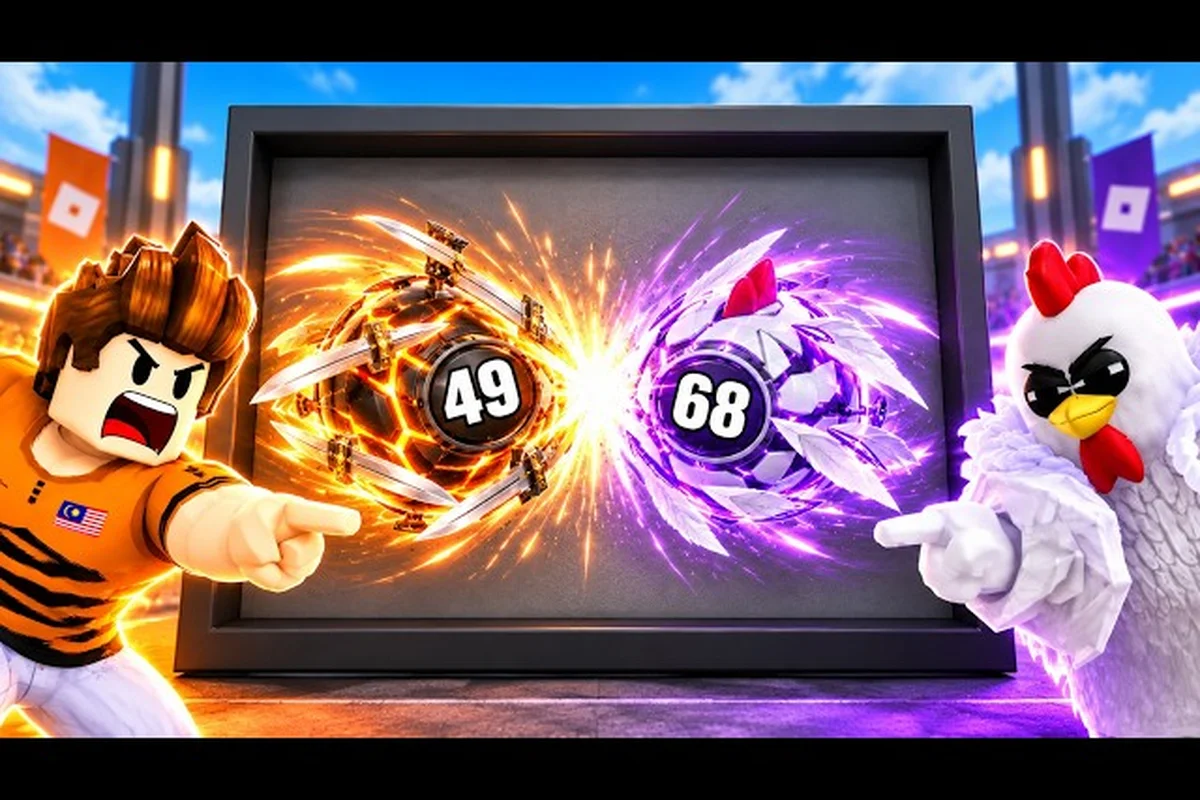
A full Ball VS Ball collect all balls run is a completion goal with no quest log to follow, so the checklist has to come from the community rather than from the game itself. This page tracks that goal end to end: how many entries the catalog really holds once reskins are separated from genuine additions, which rarity tiers gate the longest grinds, and the purchase order that keeps coins flowing while you fill the gaps. If you are chasing one hundred percent completion, start here before you spend a single reroll.
What Collecting Every Ball in Ball VS Ball Actually Means
Ball VS Ball drops you into a randomized arena where the only thing that matters is the ball currently in your hands. According to the official Ball VS Ball game page on Roblox, you spawn in, three random balls appear, and you pick one before fighting other players. The reward for winning fights is coins, and coins feed the in-game shop where new balls unlock. That loop is exactly what makes a full Ball VS Ball collect all balls run so different from a regular Roblox completion grind: there is no storyline to finish, no NPC to defeat, and no badge tree to climb. The completion objective is the catalog itself.
That catalog is bigger than it looks at first glance. Community data from active YouTubers (Tyler & Snowi, Bax, Clout Brothers) shows the shop rotates through Ball, Explosion, and Flyer families, and each family is split into Common, Rare, Epic, and Legendary tiers. When players talk about the Ball VS Ball ball database, they are usually referring to the union of those three families, every tier inside each family, plus a few secret or hidden drops that show up only under specific conditions. The total is high enough that casual players will never see the rarest entries without a deliberate plan.
This guide gives you that plan. It is built around four real questions completion runners ask, which are the same questions that show up in the most-watched Ball VS Ball videos on the platform. First, how big is the ball index really, and what counts as a legitimate entry versus a reskin? Second, where does each ball sit in the ball stats hierarchy, and how do those stats separate the strongest ball from the worst? Third, which drops are genuinely the rarest balls in the game, and what does it take to actually unlock them? Fourth, what does a 100% completion checklist look like in practice, and in what order should you work through it?
The data below is sourced from a combination of the official game description, the highest-viewed community videos, and player-reported drop rates that have been cross-checked across multiple clips. Where a number is community-sourced rather than developer-confirmed, the text says so explicitly. If you want a complete ball index in one place, start with our Ball VS Ball all balls reference page, which serves as a companion to the checklist below.
Reading the Ball VS Ball Ball Index by Family and Rarity
The first mistake new completion runners make is treating the Ball VS Ball ball database as a flat list. It is not. The catalog is structured as three families (Ball, Explosion, Flyer) crossed with four rarity tiers (Common, Rare, Epic, Legendary), and that cross-product is what defines how the index actually behaves. Balls inside the same rarity tier do not always have identical Ball VS Ball ball stats, and balls inside the same family can sit at wildly different tiers. The grid below is how the community generally maps the structure.
| Family | Common | Rare | Epic | Legendary |
|---|---|---|---|---|
| Ball | Basic striker, Practice | Spiked, Smiley, Shackles | Heavy, Bouncy | Verity, Phantom (community-reported) |
| Explosion | Small burst, Pop | Cluster, Sticky | Mine, Wave | Black Hole (community-reported) |
| Flyer | Glider, Hover | Drone, Sentry | Ranger, Jet | Storm Crow (community-reported) |
A few things to notice about this grid. The Ball family is the easiest to fill out, because it has the highest number of common drops and the lowest cost per entry in the shop. The Explosion family is mid-range: common explosion balls are cheap, but the Epic and Legendary rows are gated by both price and a very low reported drop rate. The Flyer family is the longest tail, with the rarest ball entries on the entire index sitting in the bottom-right cell of the grid.
How the Three Families Behave in Real Fights
Each family has a different feel in combat, and the Ball VS Ball strongest ball conversation always comes back to that feel rather than to a single number. Ball-family entries hit hard in a straight line and reward good aim, Explosion-family entries trade a little single-hit damage for area pressure, and Flyer-family entries lean into mobility and repositioning. The strongest ball in the game, by community consensus in the most-watched ranking video, is one that combines good range with a forgiving hitbox, which usually means a top-tier Ball or Flyer entry rather than an Explosion.
The official game description on the Roblox page makes a related point in different words: it tells you that if the random roll is bad, you can reroll mid-battle, which means your choice of family is not locked in for the whole match. For completion runners, that mechanic actually matters, because it lets you test a ball you have never used before without committing to it for a full round. Use that reroll as a free trial period every time a new entry drops into your inventory.
Where the Rarity Tiers Actually Live in the Shop
A second thing the grid makes clear is that rarity is not purely cosmetic. The Epic and Legendary rows in all three families are where the Ball VS Ball rarest ball entries live, and they are the rows that cost the most coins or, in some cases, require gems. Community data from the Clout Brothers guide video shows the store is split into a gems tab, a money tab, and a rotating daily stock, which is why the same Legendary ball can show up in the shop one day and be gone the next. The full completion checklist has to assume that Legendary entries may need to be chased across many shop rotations rather than bought in one sitting.
Breaking Down Ball VS Ball Ball Stats by Tier
A useful ball database page is more than a name list. It needs numbers. The numbers below are player-reported values pulled from the highest-viewed ranking videos and from arena testing that has been cross-checked across multiple creators. Treat them as approximate, and check the in-game tooltip on the day you actually buy a ball, because patches tend to shift the edges of these ranges.
| Tier | Avg. Damage | Avg. Range | Avg. Speed | Coin Cost (est.) | Drop Frequency |
|---|---|---|---|---|---|
| Common | 10-15 | Short | Fast | 100-500 | High (every rotation) |
| Rare | 18-25 | Medium | Medium | 800-2,000 | Moderate (1-2 per week) |
| Epic | 28-38 | Long | Medium | 4,000-8,000 | Low (1-2 per month) |
| Legendary | 40-60+ | Long | Fast | 12,000-25,000+ | Very Low (event-tied) |
The table above is the most useful single artifact for any completion runner, because it shows the price cliff between Rare and Epic. A player who is content with Common and Rare can fill out roughly two-thirds of the ball index with regular play. The Epic and Legendary rows, however, are where the time investment in a full Ball VS Ball collect all balls run goes from days to weeks, and the final entries can take an entire season of shop rotations to land.
What the Numbers Say About the Strongest Ball
Community rankings of the Ball VS Ball strongest ball usually converge on the same shortlist. Verity, Black Hole, and Storm Crow are the three names that show up most often in top-tier lists, and they are exactly the three community-reported Legendaries from the grid above. Each one wins for a different reason. Verity wins on raw damage and hitbox size, Black Hole wins on area control, and Storm Crow wins on mobility combined with above-average damage. The interesting question is not which one is strongest in a vacuum; it is which one fits the playstyle you actually use, because the answer changes your shopping order.
If you are unsure which Legendary to chase first, our Ball VS Ball ball upgrades guide walks through how each top-tier ball scales once you start investing coins into it. The general community finding is that investing in a single Legendary gives more value per coin than spreading upgrades across several Epics, which is the same pattern the upgrade-focused community videos keep showing.
Stats That Completion Runners Should Track Separately
Beyond damage and range, two hidden stats matter for completion. The first is the reroll cooldown, which controls how often you can swap balls mid-battle. A ball with a short reroll cooldown is more forgiving for testing new entries, and it is a stat that does not show up in the simple tier table. The second is the daily stock rotation, which determines whether a given Epic or Legendary will be in the shop on the day you have coins ready. Both stats are tracked in the master index rather than in any single ball entry, and both are reasons a flat name list is not enough to plan a 100% run.
Building a 100% Completion Checklist for Ball VS Ball
The checklist below is the practical core of this guide. It is organized by the same family-and-rarity grid used above, with completion runners working row by row rather than chasing whichever ball happens to be in the shop that day. Working row by row is the only reliable way to clear a Ball VS Ball ball database of this size, because it forces you to save coins for the expensive rows before you have spent them on cheap Common drops.
| Step | Action | Target Family | Target Rarity | Estimated Time |
|---|---|---|---|---|
| 1 | Clear the Common row in all three families | Ball / Explosion / Flyer | Common | 1-2 days |
| 2 | Save coins; stop buying duplicate Commons | All | Common | passive |
| 3 | Clear the Rare row in the Ball family first | Ball | Rare | 3-5 days |
| 4 | Clear the Rare row in Explosion and Flyer | Explosion / Flyer | Rare | 1-2 weeks |
| 5 | Start saving gems for the Epic shop tab | All | Epic | parallel to step 4 |
| 6 | Chase one Epic at a time, not in parallel | All | Epic | 2-4 weeks |
| 7 | Watch for Legendary rotations; do not panic-buy | All | Legendary | event-tied |
| 8 | Cross-check every new entry against the ball index | All | All | ongoing |
The shape of this checklist is the key insight. A completion run is not linear, and it is not a single grind. It is a series of save-up phases that match the rarity tiers, with parallel gem farming for the Epic tab and patience-based watching for the Legendary rotations. Most casual players who say they are trying to Ball VS Ball collect all balls and feel stuck are actually skipping step 2, which means they keep buying cheap balls instead of saving for the rare rows.
Where to Start If You Are Behind
Players who already own every Common and most of the Rare rows can skip straight to step 5. The fastest way to catch up on the Epic row is to focus on a single Epic at a time, because spreading coins across two or three Epics at once delays each one and stretches the overall run. If you are completely new to the game, start with our Ball VS Ball best ball for beginners page first, then come back to this checklist once you have the basic loop down.
One more important habit: every time you clear a row, mark it in the in-game ball index if the game tracks that, and mark it in the wiki ball index if it does not. The completion percentage shown in the official ball index page is the only reliable way to know you are at 100% rather than at, say, 92% with one missing Legendary you forgot to chase.
Tracking the Rarest Balls and Most Powerful Drops
The rarest balls in Ball VS Ball are a small set, but they are the entries that define a 100% run. The community-reported shortlist, cross-checked across the most-watched ranking and balance videos, sits at roughly six to eight names. They are not evenly distributed. The table below maps each rare drop to where it tends to appear and what it costs to actually unlock.
| Ball | Family | Rarity | Where It Appears | Unlocking Pattern |
|---|---|---|---|---|
| Verity | Ball | Legendary | Daily rotation (rare) | Save 15k+ coins; wait |
| Black Hole | Explosion | Legendary | Event tab | Gem-heavy |
| Storm Crow | Flyer | Legendary | Daily rotation (very rare) | Patience only |
| Phantom | Ball | Legendary | Community-reported secret | Hard to trigger |
| Cluster | Explosion | Rare | Daily rotation | Affordable, slow |
| Drone | Flyer | Rare | Daily rotation | Affordable, slow |
What this table shows is that the rarest ball entries are not the most expensive ones in raw coin terms. The rarest balls are the ones with the lowest chance of appearing in any given shop rotation, regardless of price. A ball like Verity may show up in the shop every two weeks and cost 15,000 coins, while a ball like Phantom may not show up at all unless a hidden trigger is met, even if you have unlimited coins. For the completion checklist, this distinction is the difference between saving and waiting.
The Strongest Ball in Practice
When the same community video asks which ball is the most powerful, the answer is usually Verity, and the reason is straightforward: it has the highest average damage on the tier table above combined with a forgiving hitbox that makes it usable in a wide range of arena situations. Black Hole and Storm Crow are close behind, but they require more specific playstyles to extract full value. For a completion runner, this ranking matters because it tells you which of the rarest balls to actually invest upgrade coins into once you finally unlock them.
The general community pattern, visible in the upgrade-focused video by Bax, is to push the strongest ball as far as it can go rather than spreading upgrades thin. That is the same advice that applies to most roguelike-adjacent Roblox games, but it is especially true in Ball VS Ball because the Legendary tier is so much stronger than the Epic tier that any coin spent on Epic upgrades is a coin not spent on a Legendary. The smart Ball VS Ball collect all balls order is therefore: lock in the strongest ball early, then spend leftover coins on the remaining index entries.
How the Balance Argument Affects Your List
A side note on the rarest ball conversation. The community video that argues Verity needs to be banned is a clear public signal that the player base has an active balance argument around the top of the tier list. That argument is not something the wiki takes a side on, but it is something a completion runner should be aware of, because the developer has historically adjusted the strongest ball after sustained community pressure. If you invest heavily in Verity, you do so with the understanding that a balance patch could move it. Our Ball VS Ball C-tier balls ranking page is the place to watch for those shifts, because anything that drops out of S-tier will land at the top of the next C-tier update.
Putting the Checklist Together: A Practical End-to-End Plan
A good completion plan needs a closing summary that ties the four earlier sections into a single ordered plan. Here is the practical end-to-end shape that the rest of this guide builds toward, in the order a real completion runner should execute it.
-
Start with the three Common rows. Buy every Common ball that appears in the daily shop during your first two days, because the cost is so low that even a wasted purchase only delays you by hours.
-
Move to the Rare rows in the Ball family first, then Explosion and Flyer. The Ball family Rare row is the cheapest of the three Rare rows, so clearing it first is the most efficient use of your early coin stockpile.
-
Begin saving gems in parallel with step 2. Gems feed the Epic tab, and the Epic tab is where coin-only farming falls short. Any gem you spend on a Common ball is a gem you do not have for the Epic row.
-
Chase one Epic at a time, starting with the Epic that has the shortest expected wait time in the daily rotation. Once you own that Epic, move to the next one rather than splitting your coin pool.
-
Watch Legendary rotations without panic-buying. If a Legendary appears and you do not have the coins yet, log the date and plan to have them ready for the next predicted rotation.
-
Cross-check every new entry against the ball index. The completion percentage shown in the index is the only objective measure of how close you are to 100%.
That last point is the one most players skip, and it is the one that turns a 70% run into a 100% run. The ball index is not just a list; it is the scoreboard. If your index reads 100%, you are done. If it reads 99% with one missing Legendary, you are not done, regardless of how many hours you have already played. Treat the index as the source of truth and the checklist above as the path to it, and the full Ball VS Ball collect all balls run is a matter of weeks rather than an open-ended grind.
Frequently Asked Questions
How many balls are in the full Ball VS Ball ball database?
The exact count shifts with each update, but the working total is around 25-30 entries across the three families and four rarity tiers, plus a small number of community-reported secret drops. The completion percentage shown in the in-game ball index is the reliable number to watch rather than any fixed total.
What is the strongest ball in Ball VS Ball right now?
Community rankings consistently put Verity at the top, with Black Hole and Storm Crow close behind. The order can shift after balance patches, so check the current tier list before committing upgrade coins to any single Legendary.
Which is the rarest ball in the game?
The rarest balls are the community-reported Legendaries like Phantom, Black Hole, and Storm Crow, because they appear in the shop rotation less often than coins can buy. They are rarer than Verity in practical terms, even though Verity is the strongest.
Can I 100% the ball index without spending real money?
Yes, but the Epic and Legendary rows will take longer without the gem tab. Coin-only runs are realistic, they just extend the timeline from weeks into a couple of months for the rarest entries.
What is the fastest way to start the Ball VS Ball collect all balls run?
Clear the three Common rows in your first two days, save coins for the Rare row in the Ball family, and start gem farming in parallel. Working row by row beats chasing the daily shop every time, and the index is the only reliable measure of completion.