
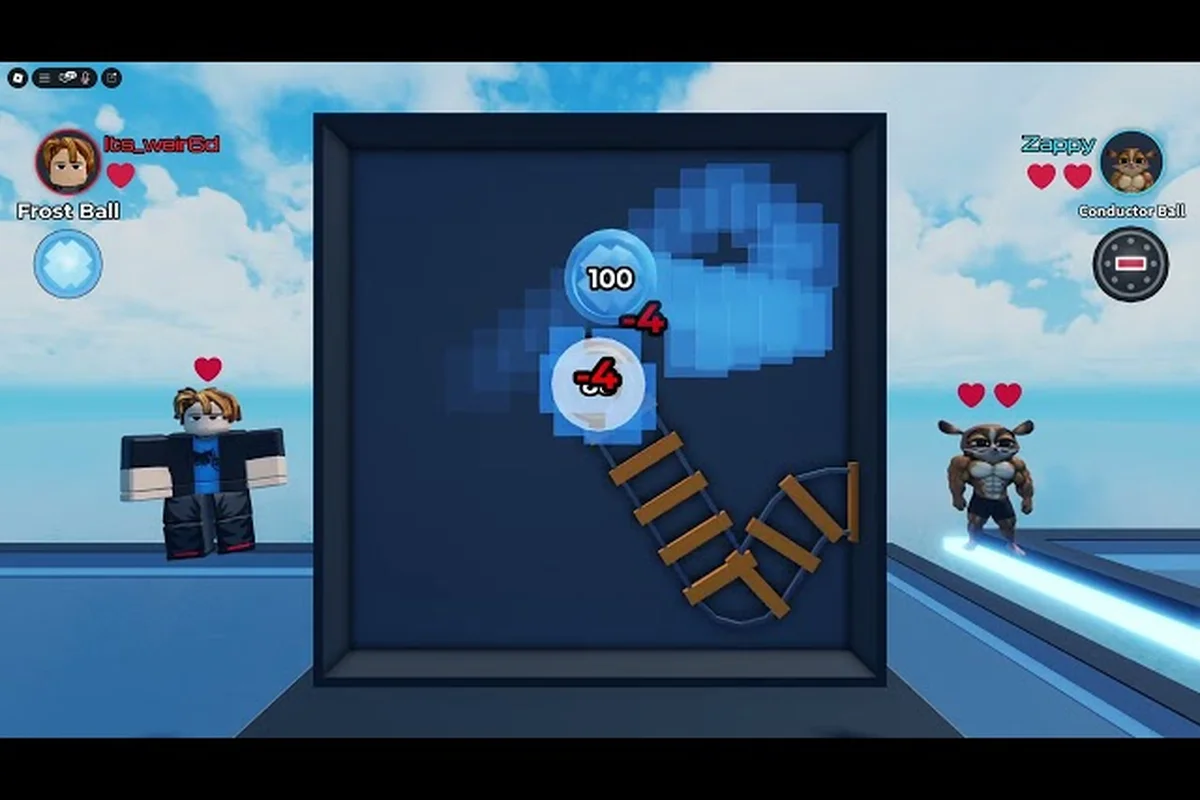
Ball VS Ball throws you straight into a Roblox arena where balls appear at random, opponents swing unpredictably, and the gap between a fresh account and a ranked regular is measured in fewer mistakes, not faster reflexes. A noob to pro climb in this game is really about three things: understanding the arena's tempo, choosing which fights to take, and turning every coin reward into a smarter purchase from the daily shop.
The official game page frames the loop in plain terms: enter the arena, fight other players, pick the ball you want when the random spawn feels right, reroll mid-battle when it isn't, win battles to earn coins, and unlock new balls in the shop. The whole Ball VS Ball noob to pro progression lives inside that sentence, so this guide treats each clause as a skill you'll practice until winning stops feeling like a coin flip and starts feeling like a habit.
What Happens Between Spawn and Victory
Before chasing any specific ball or reroll strategy, you have to internalize the basic loop the game runs on every match. The arena is a confined Roblox map where two or more players spawn in, a random ball is assigned to each fighter, and the goal is simple: stay alive while everyone else goes down. Coins are paid out for wins, the shop refreshes daily, and your collection grows whether you win or lose, as long as you keep playing.
The Core Match Structure
Every Ball VS Ball match follows the same four-phase skeleton, and reading that skeleton is the first skill separating a casual player from someone running a real noob to pro progression plan, because each phase rewards a different instinct — spawn demands a fast ball-strength read, engagement rewards positioning over panic clicks, the reroll window is the cheapest power spike in the lobby, and the resolution phase only crowns the player who timed all three correctly.
-
Spawn phase: You drop into the arena with a randomly assigned ball, and the timer begins.
-
Engagement phase: Players move around looking for picks, dodging bad matchups, and waiting for an opening.
-
Reroll window: If your ball feels weak, the game lets you reroll mid-battle, which is the single most underused tool in the early game.
-
Resolution phase: The last ball standing wins the round, and coins are paid out to the victor.
The reason this structure matters is that every Ball VS Ball gameplay tip builds on top of it. If you don't know which phase you're in, you can't decide whether to fight, dodge, or reroll, and that decision tree is where most beginners leak matches they should be winning.
Rarity Tiers and Why They Matter
Balls come in rarity tiers, and the tier you hold is a rough proxy for how strong your kit is. Players who skip past the tier system tend to reroll endlessly, while players who learn the tiers tend to save their rerolls for the moments that actually count.
| Rarity Tier | Typical Power Ceiling | Beginner Strategy | Pro Adjustment |
|---|---|---|---|
| Common | Low | Spam attacks, learn the dodge timing | Avoid relying on raw stats, focus on positioning |
| Rare | Moderate | Start tracking which rare balls you face often | Hold rerolls for an upgrade into Epic or higher |
| Epic | High | Pick fights you can actually win | Force engagements on your terms |
| Legendary | Very high | Save these for boss-tier opponents or ranked climbs | Trade only when the matchup clearly favors you |
Reading this table once won't make you a pro, but it will save you from the most common mistake new players make: treating every rarity the same. A Legendary ball is not "a bit stronger" than a Common ball; it can flip a losing matchup into a winning one, and the players who climb fastest are the ones who save their best rolls for the fights that decide the round.
Ball VS Ball What to Do First: The First-Match Checklist
When you load Ball VS Ball for the first time, the screen throws a lot at you, and the instinct is to click through it. Resisting that instinct is the single biggest jump from noob to pro behavior, because the first five minutes of any Roblox session are where your account's long-term economy is decided.
Join the Developer Group
According to the official game description, joining the developer's group is the stated free-reward path, and the ATYS 3 group on Roblox had over 1.26 million members as of late 2025. There is no separate redeem code system, so this group join is the practical "free stuff" route in Ball VS Ball, not a hidden feature. The official Ball VS Ball game page makes the same point directly, listing the group join as one of the core onboarding steps.
Play Three to Five Matches Without Spending Anything
Your first sessions are not the place to test the shop. Instead, run a small streak of 3–5 unranked matches using only your default ball loadout, paying close attention to the arena geometry, the standard round timer, and how respawn points are positioned across each map. Treat this stretch the same way a ranked player would treat a warm-up block: identical ball, identical spawn, zero coin input, so the only variable left to study is the arena itself and the spawn-roulette distribution your account is actually rolling against.
-
How fast a typical round resolves
-
Which balls you see most often in random spawns
-
How the reroll button feels on your platform (mobile vs. PC)
-
Which arena sections players tend to clump in
This is your ball vs ball learning the arena phase, and skipping it is why so many new accounts blow their early coins on a ball they never learn to use. The default loadout in the opening 3–5 unranked matches is the same low-traction, neutral-stats ball every fresh account rolls, which means every input you make — jump height, roll arc, bounce angle off arena walls, respawn-to-objective travel time — is read against the unmodified spawn-roulette distribution rather than masked by a premium skin's hidden handling bonuses. Veteran players who grind the arena-baseline phase first can usually predict within one or two seconds where a contested bounce will settle on maps like Cylinder and Split, and that prediction gap is the entire reason the early coin sink hurts newer accounts: they buy a ball with stats they have never learned to read against the maps they have never learned to time.
Identify Your First "Anchor" Ball
After five or six matches, you'll notice that one or two ball types keep showing up in your wins, even when you weren't trying. That's your anchor ball, and the Ball VS Ball beginner guide to progression recommends building your early account around it. An anchor ball is not the strongest ball in the game; it's the ball you understand deeply enough that you can win with it on a bad spawn, which is the kind of reliability that compounds over hundreds of matches.
Players who skip the anchor step end up rotating balls every match, chasing whatever the Ball VS Ball tier list currently calls "S-tier" and never building the muscle memory that separates a noob from a pro. An anchor ball only works if you play it for at least 30-50 matches — that's the threshold where you stop thinking about its arc, cooldown, and bounce pattern, and start reacting to your opponent's position instead. Without that repetition, every clutch moment in the arena devolves into button-mashing, and the Ball VS Ball learning curve resets itself every single match.
Ball VS Ball Gameplay Tips: Reading Opponents and Matchups
A Ball VS Ball noob to pro climb stalls fastest when players treat every opponent the same. Pro-level play is built on reading who you're fighting, and the game gives you more information than most beginners realize. Start by noting your rival's arena corner preference — aggressive players camp the boost pad lane, while defensive rollers hug the rim for last-second dodges. Check their color-flash timing on dash: a 0.3-second flash window signals an incoming ram, letting you pre-jump instead of trading mass. Track their score gap behavior too; an opponent down by 2+ balls often switches to desperation charges you can bait into the hazard strip. These three reads — corner bias, dash flash, score pressure — separate noob reaction play from pro prediction play, and each one only takes a few matches to start spotting.
Read the Spawn, Not the Player
When two balls load into an arena, the ball on your side of the screen tells you as much about the round as the opponent's. A low-rarity spawn against a high-rarity opponent is your cue to disengage and look for a reroll, while a high-rarity spawn into a Common opponent is your cue to press the engagement. This is one of the most reliable ball vs ball gameplay tips in the entire game, because the spawn information is freely available before either player has spent a single move.
Track Reroll Cooldowns
Every player has a reroll, and a good player tracks when that reroll is likely to come out. If you pressure an opponent hard and they suddenly swap to a different ball mid-fight, the cooldown window is your best chance to land a kill. Players who don't track cooldowns are easy to read, and players who do track them rack up wins that look "lucky" to spectators but are actually pattern recognition.
Use the Arena Geometry
Ball VS Ball arenas have corners, ramps, and chokepoints, and the pros use every one of them: every map variant ships with at least two corner pockets, one or two ramp pieces (some tilted, some flat-topped), and a narrow chokepoint connecting the spawn side to the center, and pro players mentally map these three zones before the first round even starts so they always know where their escape, their high ground, and their kill lane are at a glance.
-
Corners are escape routes, not traps. If you back yourself into one, you have one exit, and a good player will cut that exit before you can move.
-
Ramps break line-of-sight for some ball types and extend it for others, so learning which ball benefits from elevation is a free advantage.
-
Center open ground is where most random fights resolve. If you don't want to fight yet, leave the center, and let the early chaos thin the lobby for you.
If you want a deeper breakdown of how to survive longer in these late-round scenarios, the Ball VS Ball last one standing tips guide covers the exact rotations experienced players use when the lobby shrinks to two or three.
Building a Pro Economy: Coins, Gems, and Smart Shop Spending
Coins and gems are the two resources that separate a fresh account from a veteran one, and Ball VS Ball pays them out at very different rates. According to the official description, winning battles is the stated source of coins, which means win rate is the single most important economic stat in the game.
Coin Income by Match Type
The following table summarizes the typical coin economy of a Ball VS Ball session, drawing on community-reported match data and player guide averages: common-tier wins usually yield roughly 15-25 coins, rare-tier wins around 40-60 with occasional gem drops, and even losses return a small consolation payout near 5-10 coins so you stay queue-eligible. These ranges vary by arena modifiers and daily shop restock timing, so treat them as ball vs ball learning the arena baselines rather than fixed values.
| Match Outcome | Typical Coin Reward | Gem Reward | Net Account Value |
|---|---|---|---|
| Win (Common) | Low | None | Slow but stable |
| Win (Rare+) | Moderate | Occasional | Strong growth |
| Loss (any tier) | Small | None | Keeps you in matches |
| Daily shop restock | None | None | Forces a decision |
The takeaway is straightforward: wins matter, but consistency matters more. A player who wins one in three matches but plays twenty matches a day is accumulating coins faster than a player who wins one in two but only plays five. Ball vs ball learning the arena really means learning how to play enough matches that the economy compounds, because a 10% win rate boost over 200 matches is worth more than a 30% boost over 20.
When to Spend, When to Save
The single most common beginner mistake in Ball VS Ball is panic-buying from the daily shop the moment a Legendary appears. The shop rotates across Ball, Explosion, and Flyer families at Rare, Epic, and Legendary tiers, and the Ball VS Ball daily shop guide walks through the specific rotation patterns, but the high-level rule is simple: only buy a Legendary if it upgrades an existing matchup, not if it's just a shiny new addition to your collection.
| Shop Decision | Beginner Tendency | Pro Tendency |
|---|---|---|
| Legendary on first sight | Buy immediately | Wait, check if it covers a real weakness |
| Epic at half-off | Buy on impulse | Buy only if it stacks with an anchor ball |
| Duplicate Rare | Skip as a waste | Sometimes buy to reroll into a higher tier |
| Skip a restock | Never skip | Skip often; bank coins for Legendary restocks |
Two coins held back for a Legendary restock that upgrades your Explosion ball counter become a permanent power spike, while two coins burned on a duplicate Rare that doesn't shift any matchup are gone forever — and the coin economy in Ball VS Ball resets slowly enough that impulsive Legendary purchases at full price can stall an entire account's growth by a full rotation cycle.
Common Beginner Mistakes That Stall a Noob to Pro Climb
Every Ball VS Ball gameplay tip in the world is wasted if you keep repeating the same five beginner mistakes, and most players do, because the game doesn't punish them obviously until much later. Here are the most common ones, ranked by how much they cost your win rate.
Mistake 1: Fighting Every Engagement
Beginners see another ball and immediately attack. Pros see another ball and ask whether the spawn, the cooldown, and the arena position all favor them. If the answer to any of those three is no, a pro player disengages and waits for a better window. The cost of fighting every engagement isn't just the matches you lose; it's the rerolls you burn on fights that were unwinnable from the start.
Mistake 2: Panic Rerolls
Reroll is a tool, not a habit. Using it the moment you spawn into a Common ball guarantees you'll never learn the matchups that make a Common ball viable, and it burns a resource you can't get back. A solid ball vs ball full guide approach is to reroll only when the opponent's ball clearly counters yours, not when the spawn simply feels unfamiliar.
Mistake 3: Ignoring the Developer Group
This one comes up constantly in community reports: players who never join the ATYS 3 group are missing out on the only "free stuff" channel the game has. The official description calls it out directly, and players who join early report a smoother early economy. There's no reason not to do it, and the cost is about ten seconds of clicking.
Mistake 4: Buying Balls You Don't Understand
The shop sells balls, but it doesn't sell ball knowledge. A Legendary you can't use is worth less than an Epic you've practiced with for fifty matches. Building a real ball vs ball noob to pro progression means treating new purchases as experiments, not upgrades, until you've tested them in real fights.
Mistake 5: Skipping Match Variety
Players who only play one map, one ball family, or one time of day hit a plateau fast. Variety is what teaches you the small patterns the pros use, and the Ball VS Ball new player guide goes deeper on the "play more, play wider" approach that breaks plateaus.
Turning a Noob Account Into a Pro Account Over Time
A noob to pro climb in Ball VS Ball is measured in weeks, not hours, and the players who make it are the ones who treat the climb as a system rather than a streak. The system has four moving parts, and you have to keep all four turning at once.
The Four Levers of Pro Progression
-
Match volume: Play enough matches that the economy and the muscle memory both compound.
-
Anchor depth: Pick one or two balls and learn them so well that bad spawns still give you a chance.
-
Shop discipline: Spend only when the upgrade covers a real weakness, and skip restocks that don't.
-
Cooldown tracking: Read opponents well enough that you know when their reroll is coming and when their strongest move is on cooldown.
A player who only improves one of these four will plateau. A player who improves all four gradually will see a steady climb in win rate, and that climb is the most reliable signal that a noob to pro transition is actually happening.
Building the Habit Loop
The reason the four levers work is that they reinforce each other. More match volume gives you the data to refine your anchor. Anchor depth makes your shop decisions more accurate. Shop discipline keeps your coin economy healthy. Cooldown tracking turns small edges into consistent wins. Each piece is small on its own, but together they build a playstyle that looks effortless from the outside, even though it rests on hundreds of small decisions made correctly.
If you want a side-by-side look at the specific habits that separate higher-ranked players from the rest of the leaderboard, the Ball VS Ball leaderboard guide goes into the rank-up details and the common do-and-don't patterns that hold players back.
Ball VS Ball Full Guide Recap: The Noob to Pro Mindset
The fastest way to summarize a Ball VS Ball full guide is this: the game rewards players who treat randomness as a problem to manage, not a complaint to make. Spawns are random, but your response to a bad spawn is not. Opponents are unpredictable, but their reroll cooldowns are not. The shop is volatile, but your spending discipline is entirely in your hands.
A noob to pro climb in Ball VS Ball is the accumulation of small, repeatable decisions made correctly across hundreds of matches, and the players who reach the top of the leaderboard are not the ones who got lucky; they are the ones who stopped leaking matches they should have won. That is the entire game, and the rest of this guide is just a way of making each of those decisions slightly easier to make.
Frequently Asked Questions
How long does a typical Ball VS Ball noob to pro climb take?
Most players who play daily and follow a structured ball vs ball full guide see real win-rate improvement within two to three weeks. The exact timing depends on match volume, but the climb is about consistency, not a single breakthrough session.
What should a beginner buy first from the Ball VS Ball daily shop?
Buy a ball that covers a weakness in your anchor's matchups, not the rarest ball on the shelf. A Rare or Epic that fits your playstyle will outperform a Legendary you don't know how to use, and the Ball VS Ball daily shop guide covers how to read each restock.
Is the reroll button worth using in early matches?
Yes, but only when the opponent's ball clearly counters yours on the arena. Beginners who reroll every Common spawn never build the matchup knowledge they need, and a solid ball vs ball gameplay tips approach is to reroll strategically, not reflexively. Track which of the 5 default spawn types your anchor loses to most often in your first 10 matches, then reroll specifically into the ball that flips that matchup.
Does joining the ATYS 3 group actually help?
According to the official game description, joining the developer's group is the listed free-reward path, since Ball VS Ball has no separate code system. The ATYS 3 group on Roblox is the only channel the developer runs, so it's the practical "free stuff" route in the game.
What is the single biggest beginner mistake in Ball VS Ball?
Fighting every engagement. Learning when to disengage, save your reroll, and wait for a better window is the fastest way to turn a noob account into a pro one, and it's the habit most clearly visible when you watch high-rank players in action.